 Daily GCSE
The science behind better revision.
Little. Often. Effective. Daily GCSE is built on a simple idea, backed by research into how students learn: regular practice, recalling what you know, and learning from feedback.
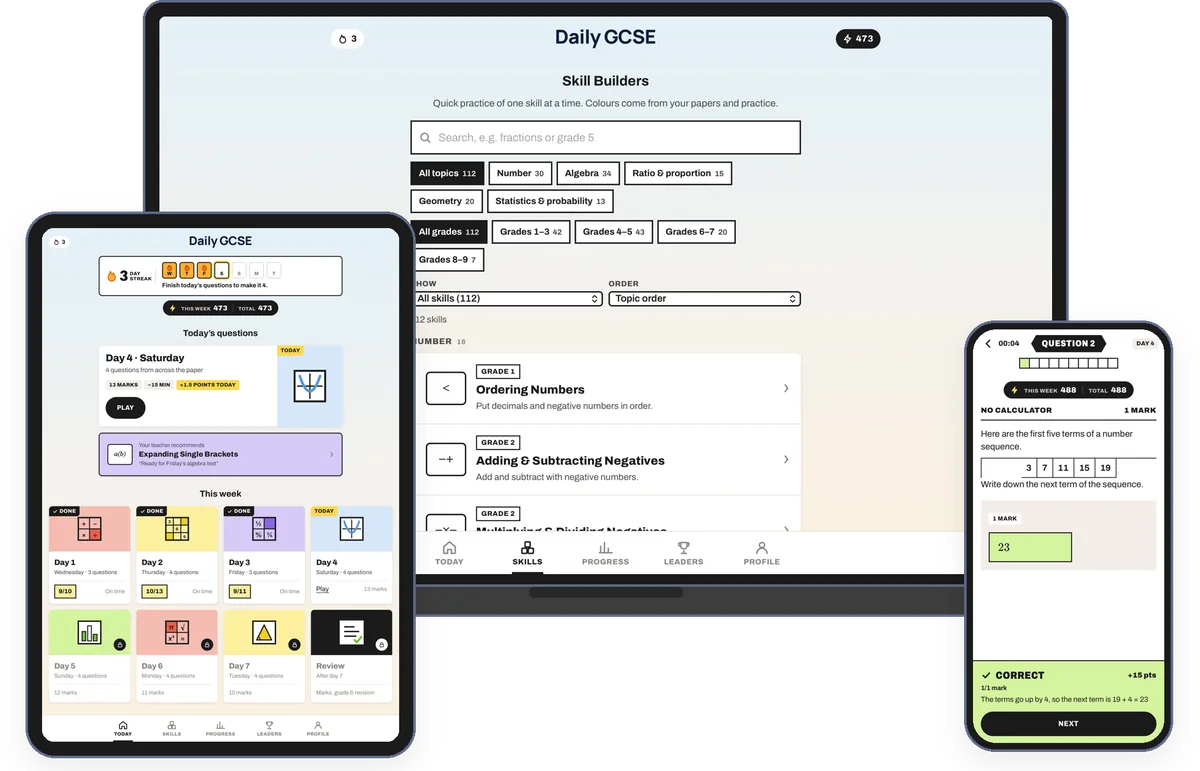
By splitting a GCSE maths paper into a few questions a day, Daily GCSE makes that kind of revision easier to keep up: a little practice every day, instant marking, and a clear picture of what to revise.
Three findings worth knowing
Practice testing and spaced practice
A major review of ten learning techniques rated just two as high utility: practice testing and spreading practice out over time. They helped learners of different ages and abilities, across many kinds of task, including in real classrooms.
Source: Dunlosky et al. (2013)
Effective feedback
The Education Endowment Foundation rates feedback as high impact for very low cost, based on extensive evidence: on average, six months' additional progress across the studies it reviewed.
Mixed maths practice
In a classroom experiment, students who practised a mix of maths problem types scored 72% on a test two weeks later, compared with 38% for students who practised the same kind of problem in blocks.
Source: Rohrer, Dedrick & Burgess (2014)
* An average across many feedback studies, not a measured impact of Daily GCSE. The EEF notes that feedback delivered by digital technology also has positive effects, though slightly lower than the overall average.
† One study, with 140 Grade 7 students in the US (roughly Year 8 in England). Not a GCSE exam, and not a prediction of Daily GCSE results.
How Daily GCSE puts it into practice
A little practice, repeated regularly.
Recalling and applying what you know, rather than rereading notes or watching explanations, strengthens learning. The research calls it practice testing, or retrieval practice.
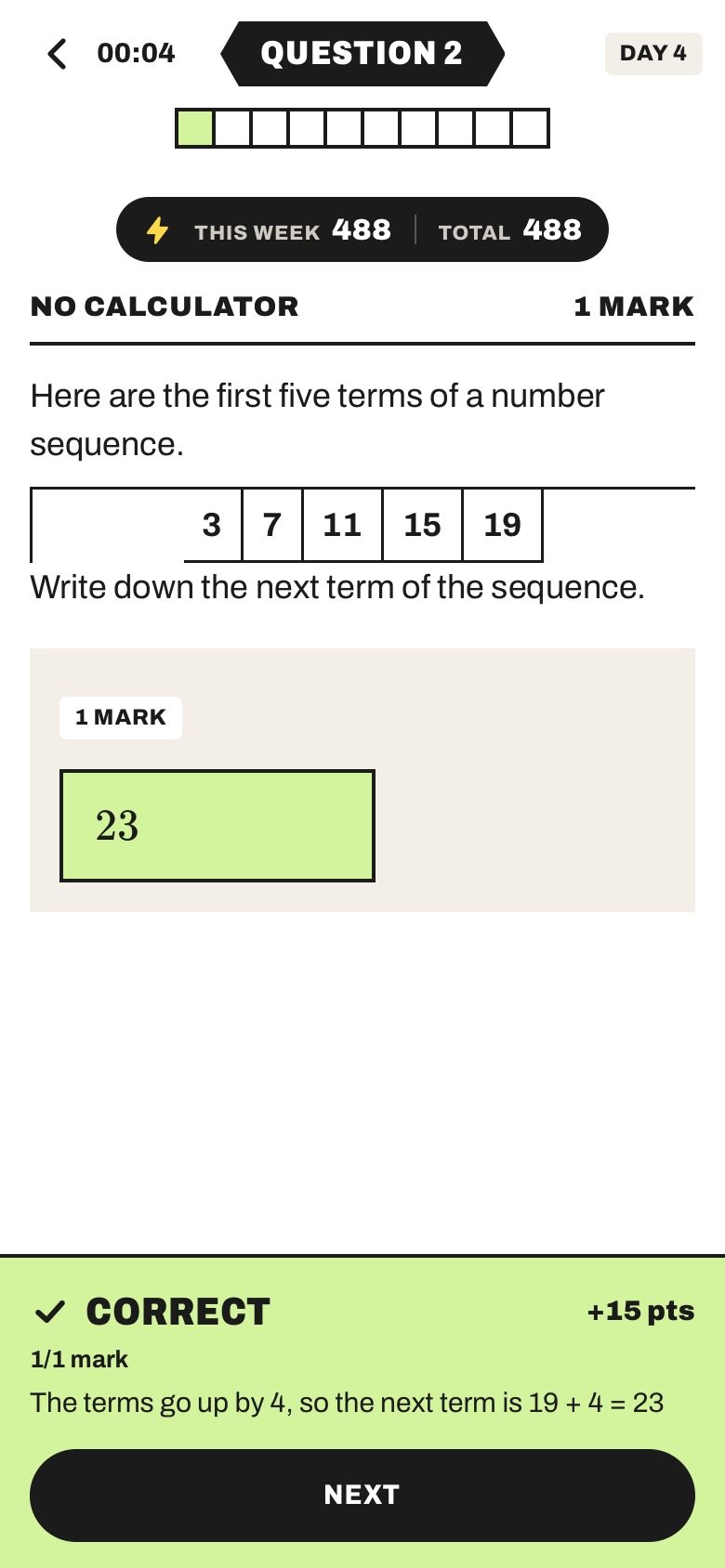
Daily GCSE puts this into practice with real exam-style questions every day. Students do a few questions a day and build up to a whole paper over a week.
Source: Dunlosky et al. (2013)
Revision shouldn't start the night before.
Students often cram revision into long sessions just before a test. Research shows that spreading the same practice over several sessions tends to help students remember it for longer.
Daily GCSE spreads each paper over 5 or 7 days, so students come back to maths little and often and build a routine. (The research supports spacing practice out; it doesn't say a week is the ideal gap.)
Source: Dunlosky et al. (2013)
Every answer is a chance to learn.
Feedback works best when it tells learners how they did and what to do next, and when it covers what they got right as well as what they got wrong.
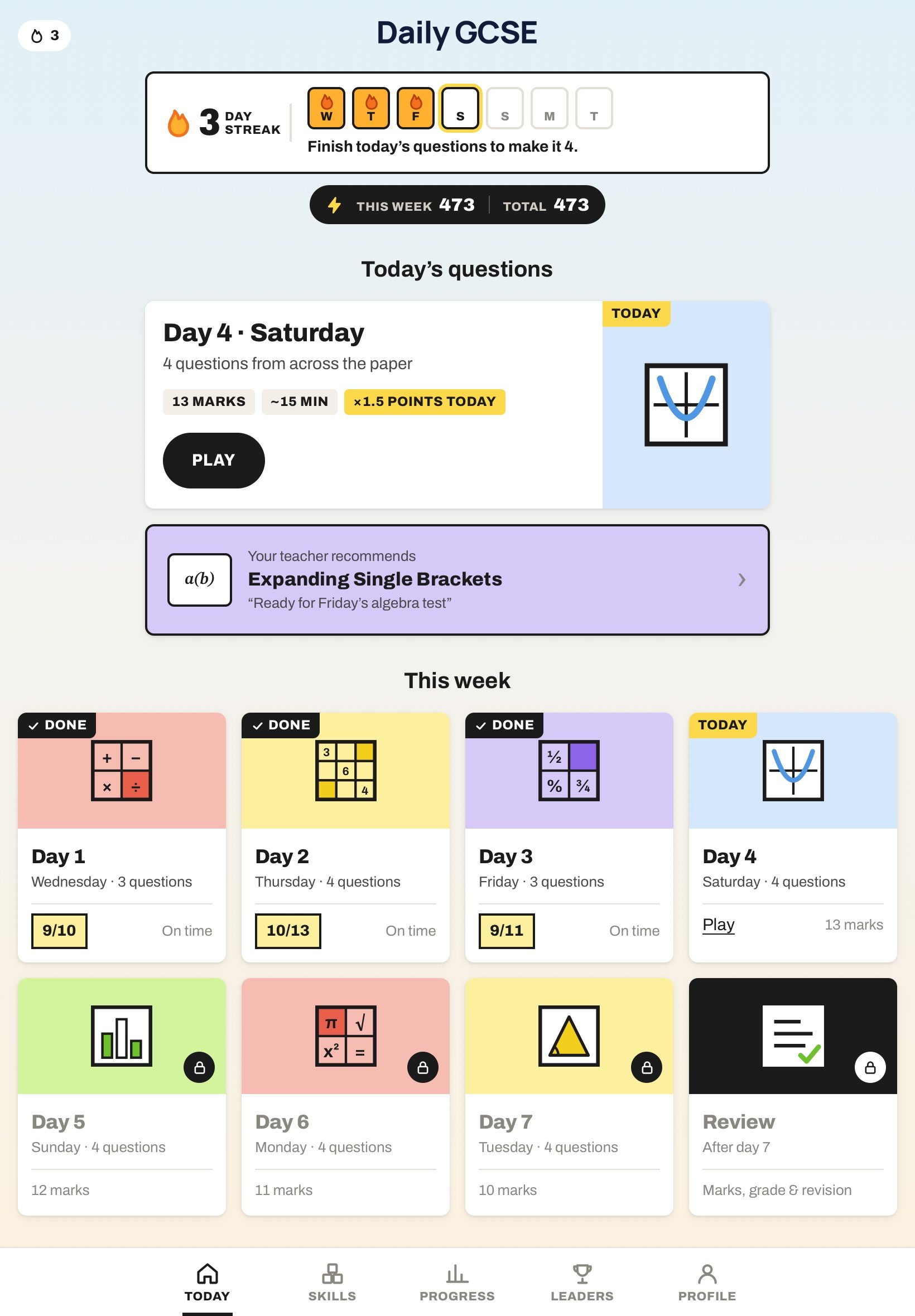
Every answer in Daily GCSE is marked straight away, while the question is still fresh, with hints and worked answers on every question. At the end of each paper, students see their mark, grade and the topics to revise.
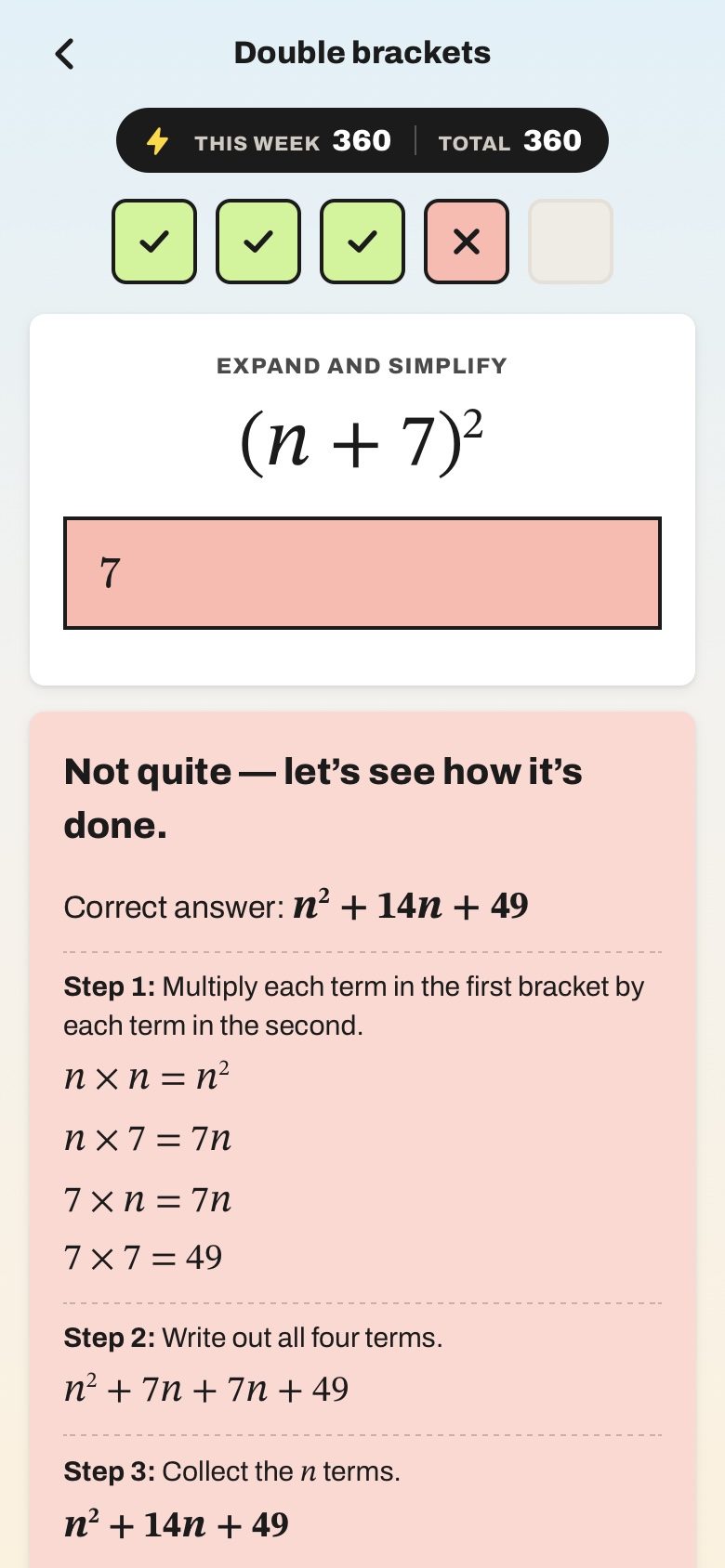
Why mixing maths questions matters.
Real GCSE papers don't tell students which method to use. They have to recognise the kind of problem, choose a strategy and apply it.
Research suggests that mixing different types of maths problem during practice helps students learn to do this, as in the study above. Each day of a Daily GCSE paper takes questions from across the paper, so topics are naturally mixed, as they are in the exam. The review by Dunlosky and colleagues rated this kind of interleaved practice as promising (moderate utility), with more research still needed.
Source: Rohrer, Dedrick & Burgess (2014)
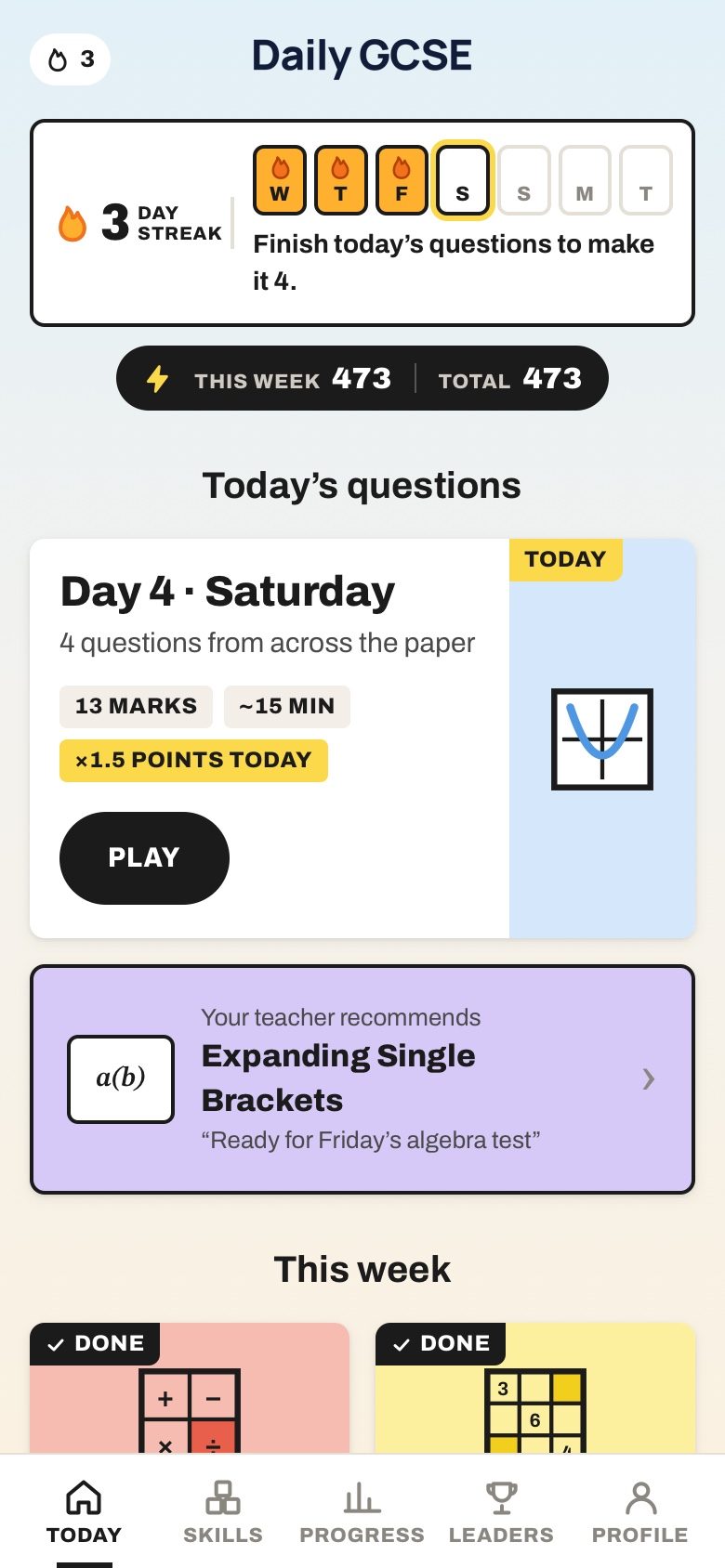
Find the gaps. Build the skills.
Answering more questions isn't enough on its own: students also need to work on what they get wrong. Daily GCSE links exam practice to Skill Builders, short practice on one skill at a time with hints, worked examples and instant feedback.
- PractiseA few exam questions a day
- FeedbackMarked straight away
- Find the gapsTopics to revise, from their answers
- Build the skillA Skill Builder for each gap
- Practise againThe next paper
Each gap points to a Skill Builder.
When a paper shows a gap, the skill behind it is flagged straight away, with the question it came from, so students know exactly what to practise next.
- Needs work and getting there, from their own paper answers.
- Five in a row to master a skill.
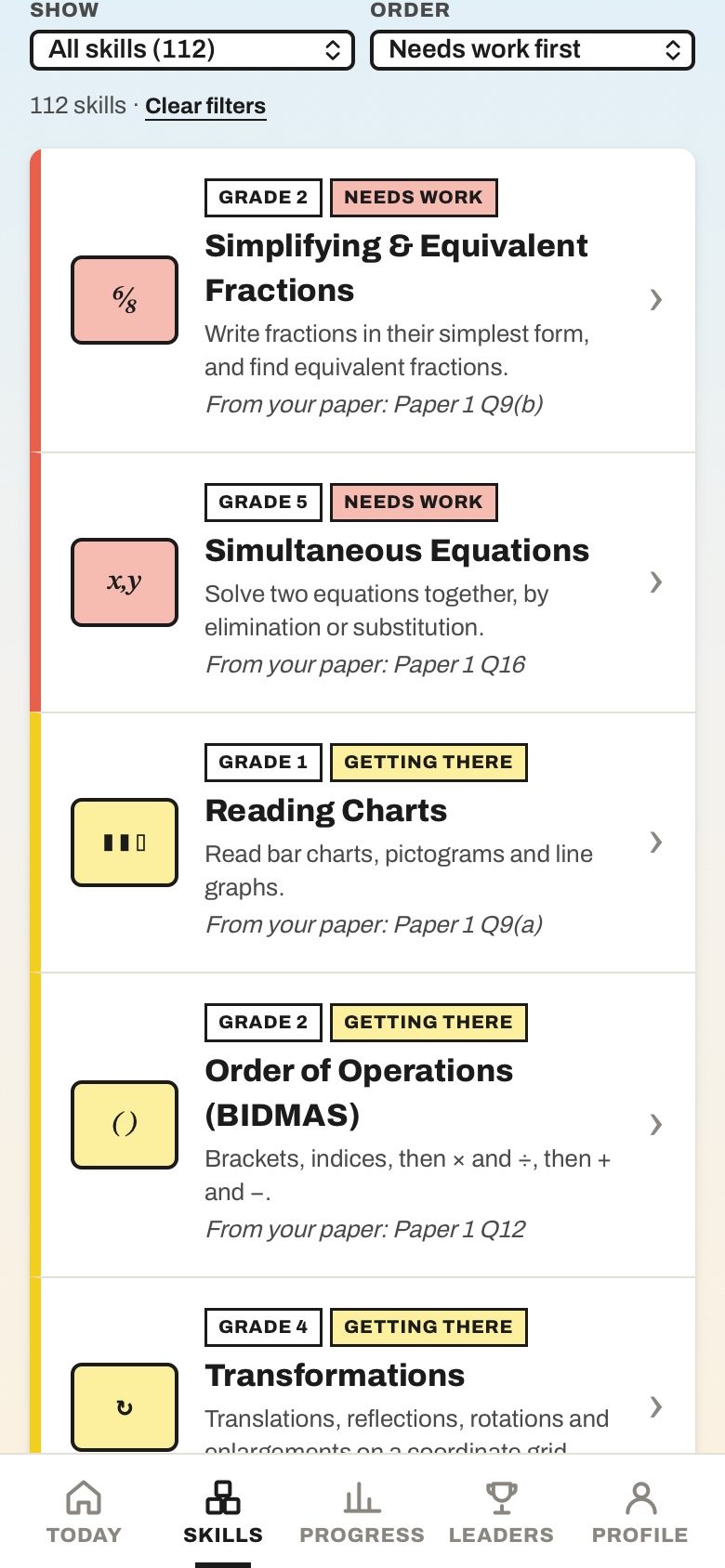
This follows the principles of feedback and formative assessment. Skill Builders haven't been independently tested for their effect on GCSE grades.
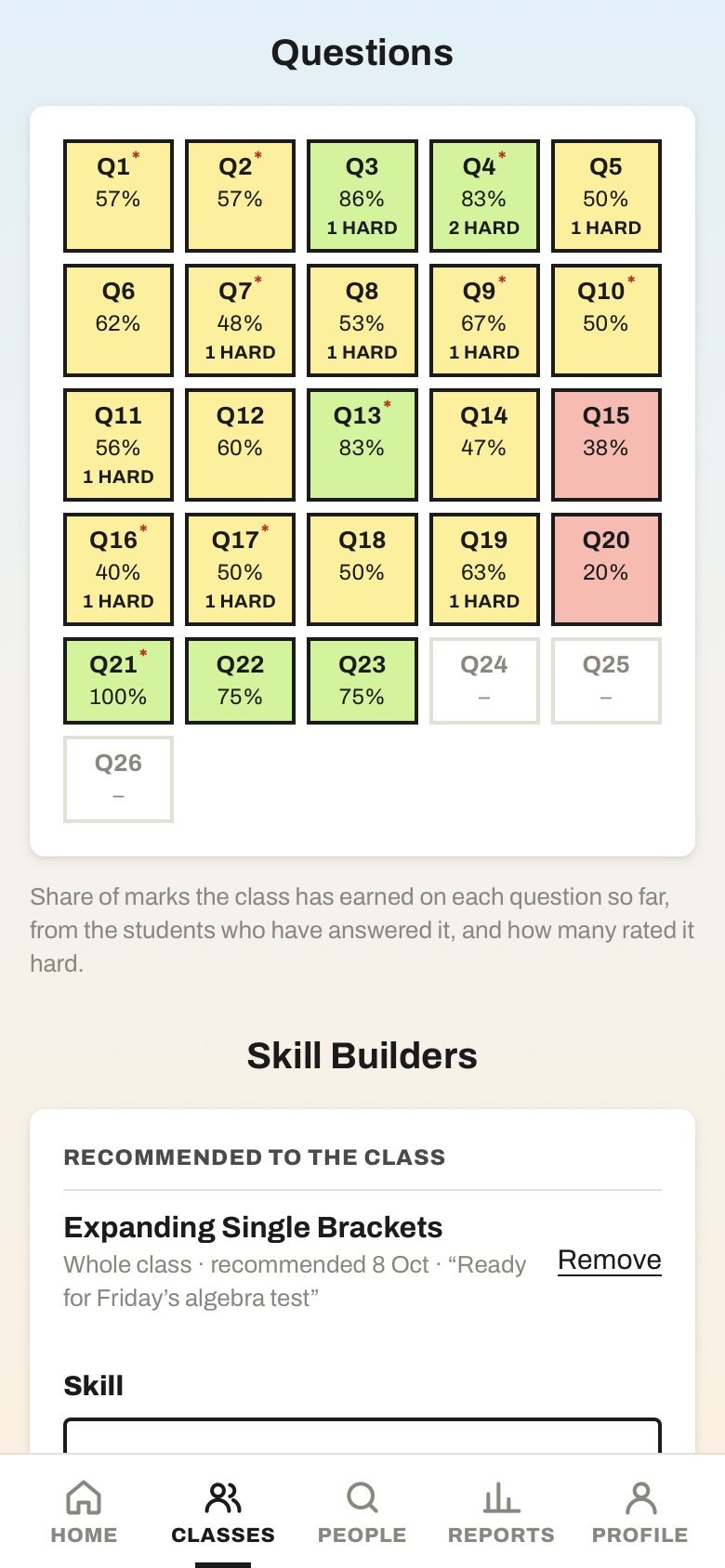
See what the class finds hard.
Formative assessment means using what students' answers show you to decide what to teach next. Daily GCSE gives teachers the information without the marking.
- Question by question: every student against every question, so gaps jump out.
- Across every week: topics each student is consistently struggling with, or strong on.
- Recommend a Skill Builder to the class, or to one student, in a tap.
Research-informed revision, at a glance
| Principle | In Daily GCSE | For your school |
|---|---|---|
| Practice testing | Exam-style questions every day | More chances to recall and apply learning |
| Spaced practice | Each paper spread over 5 or 7 days | A steady revision habit, not last-minute cramming |
| Feedback | Instant marking, hints and worked answers | Students learn from mistakes while they're fresh |
| Mixed practice | Every day mixes topics from across the paper | Practice at choosing the right method, as in the exam |
| Targeted practice | Skill Builders for the topics to revise | Extra practice exactly where it's needed |
| Formative assessment | Question-by-question results for every class | Teachers see the gaps without marking |
Daily GCSE doesn't reinvent revision. It makes research-informed revision easier to put into practice.
Built on research. Measured in classrooms.
Daily GCSE puts well-researched principles into practice every day: practice testing, spaced practice, mixed practice and feedback. The research behind them is strong, and like any approach, results depend on how it's used.
We're now working with schools to measure Daily GCSE's own impact. The figures on this page come from the published research, not from Daily GCSE itself.
Interested in being a pilot school? Get in touch.
References
- Dunlosky, J., Rawson, K. A., Marsh, E. J., Nathan, M. J., & Willingham, D. T. (2013). Improving students' learning with effective learning techniques: Promising directions from cognitive and educational psychology. Psychological Science in the Public Interest, 14(1), 4–58. doi.org/10.1177/1529100612453266
- Education Endowment Foundation. Teaching and Learning Toolkit: Feedback. educationendowmentfoundation.org.uk
- Perry, T., et al. (2021). Cognitive science approaches in the classroom: A review of the evidence. Education Endowment Foundation. educationendowmentfoundation.org.uk
- Rohrer, D., Dedrick, R. F., & Burgess, K. (2014). The benefit of interleaved mathematics practice is not limited to superficially similar kinds of problems. Psychonomic Bulletin & Review, 21(5), 1323–1330. doi.org/10.3758/s13423-014-0588-3
Put research-informed revision into practice.
Regular exam practice, instant feedback and targeted skills in one place, with the results your teachers need.
Email us at hello@threetalents.co.uk