 Daily GCSE
127 skills. Endless practice.
Short, focused practice on one GCSE maths skill at a time. Every question is new, every answer is marked straight away, and five in a row makes a skill secure.
How Skill Builders work
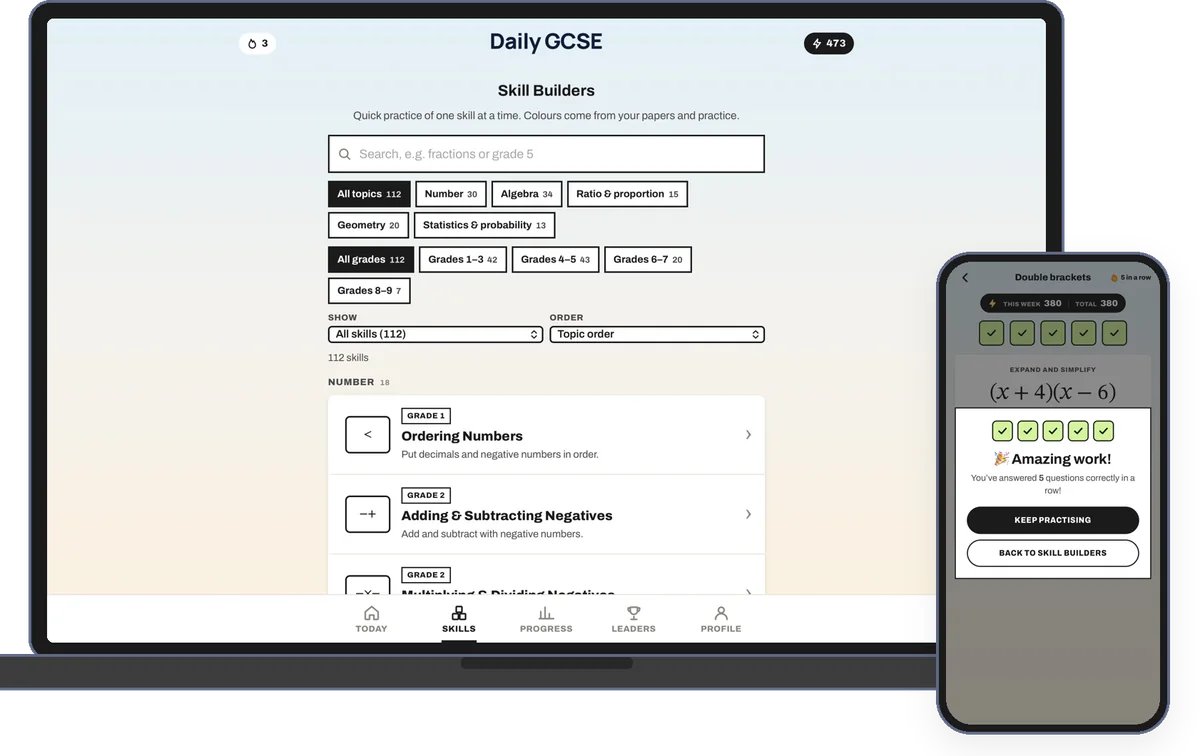
Every topic, from grade 1 to 9.
Skill Builders cover Number, Algebra, Ratio and proportion, Geometry, and Statistics and probability. Search for a skill, or filter by topic and grade.
- Grade bands from 1–3 up to 8–9, with the typical GCSE grade on every skill.
- 29 Higher-only skills are tagged, so Foundation students know what to skip.
- Sort by topic, by grade, or with the skills that need work first.
New questions, every time.
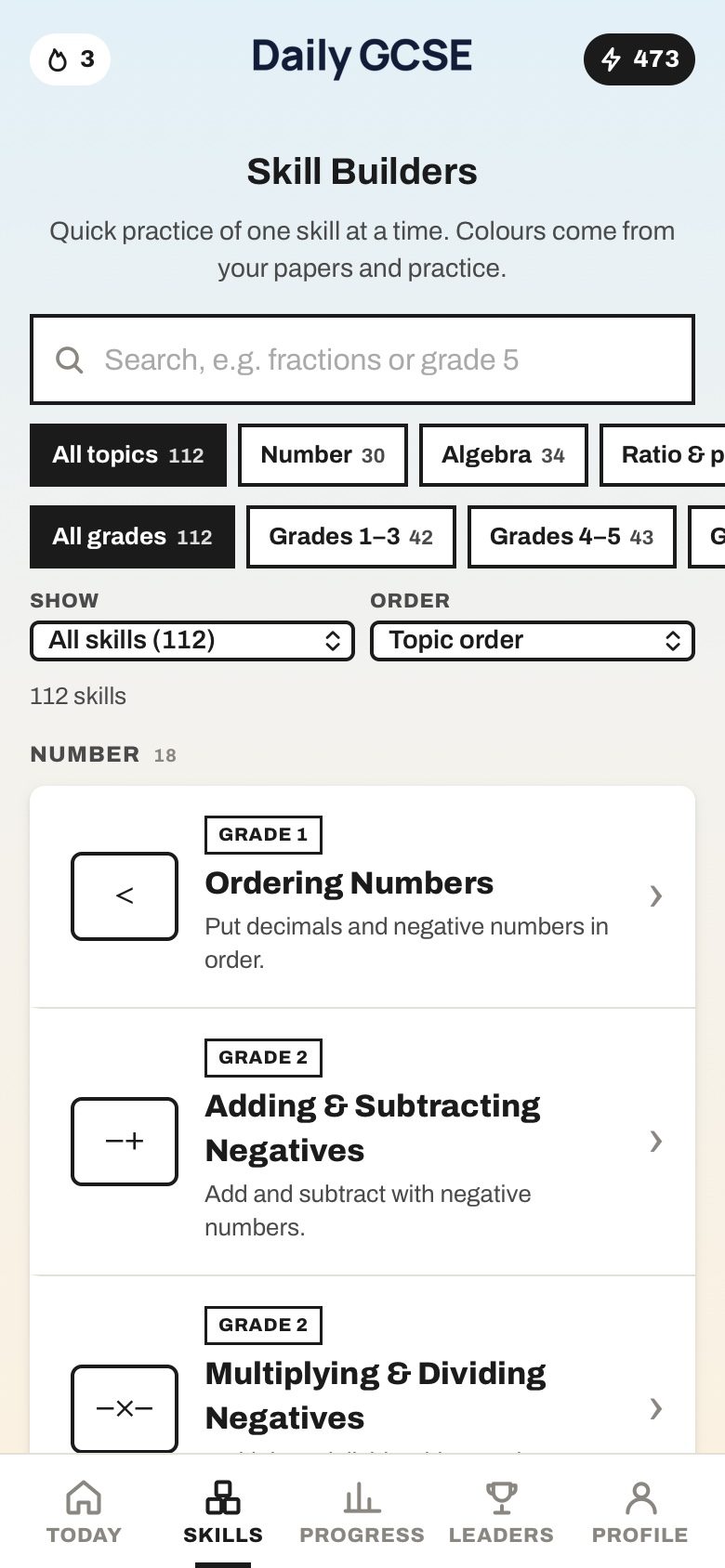
Each skill writes its own questions, with diagrams drawn fresh, so there's always another to try. Questions get harder as your last five answers improve, and recent ones don't come straight back.
- A maths keyboard for powers, fractions, roots and angles.
- A calculator only on skills where the exam would allow one.
- Slips aren't marked wrong. Leave a bracket in and you're asked to finish multiplying out, not marked down.
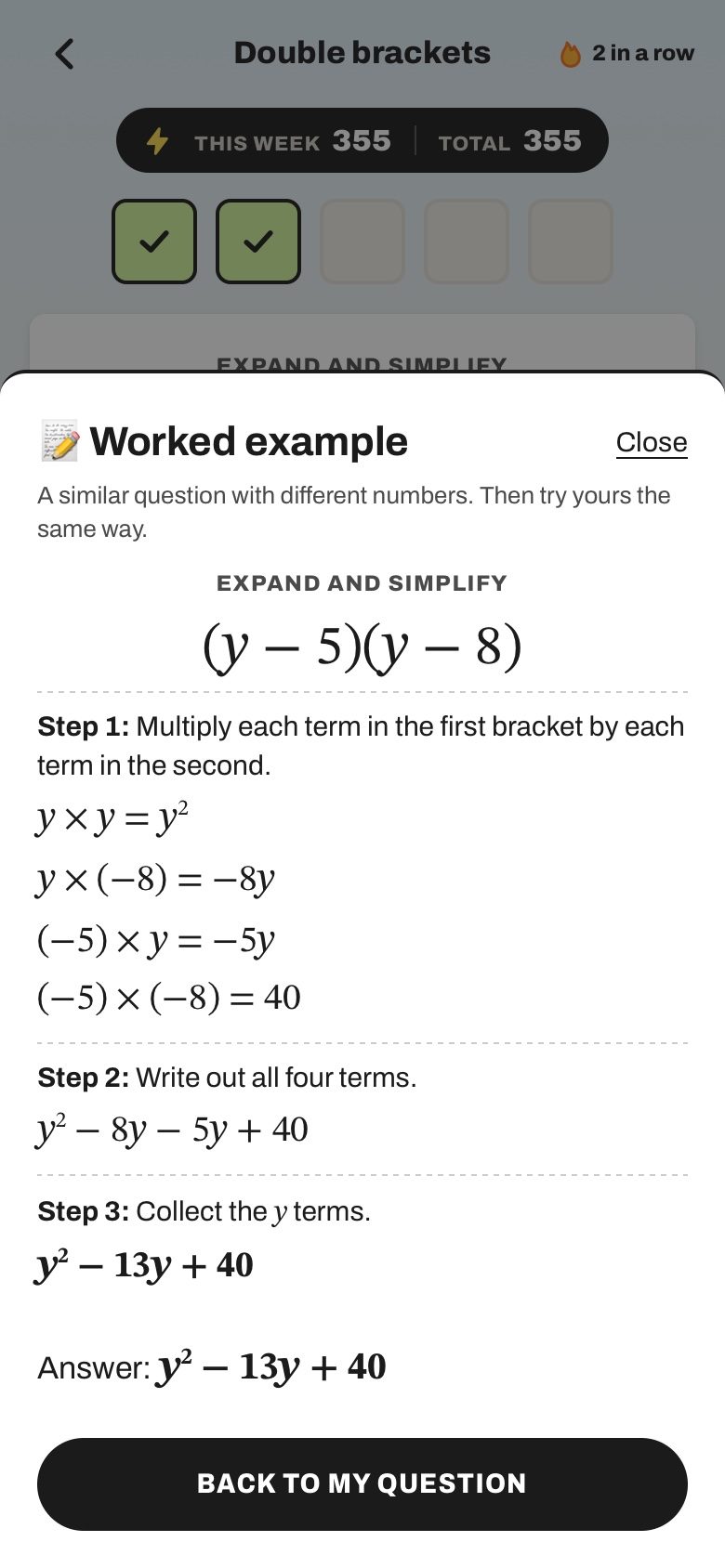
A hint, or a worked example.
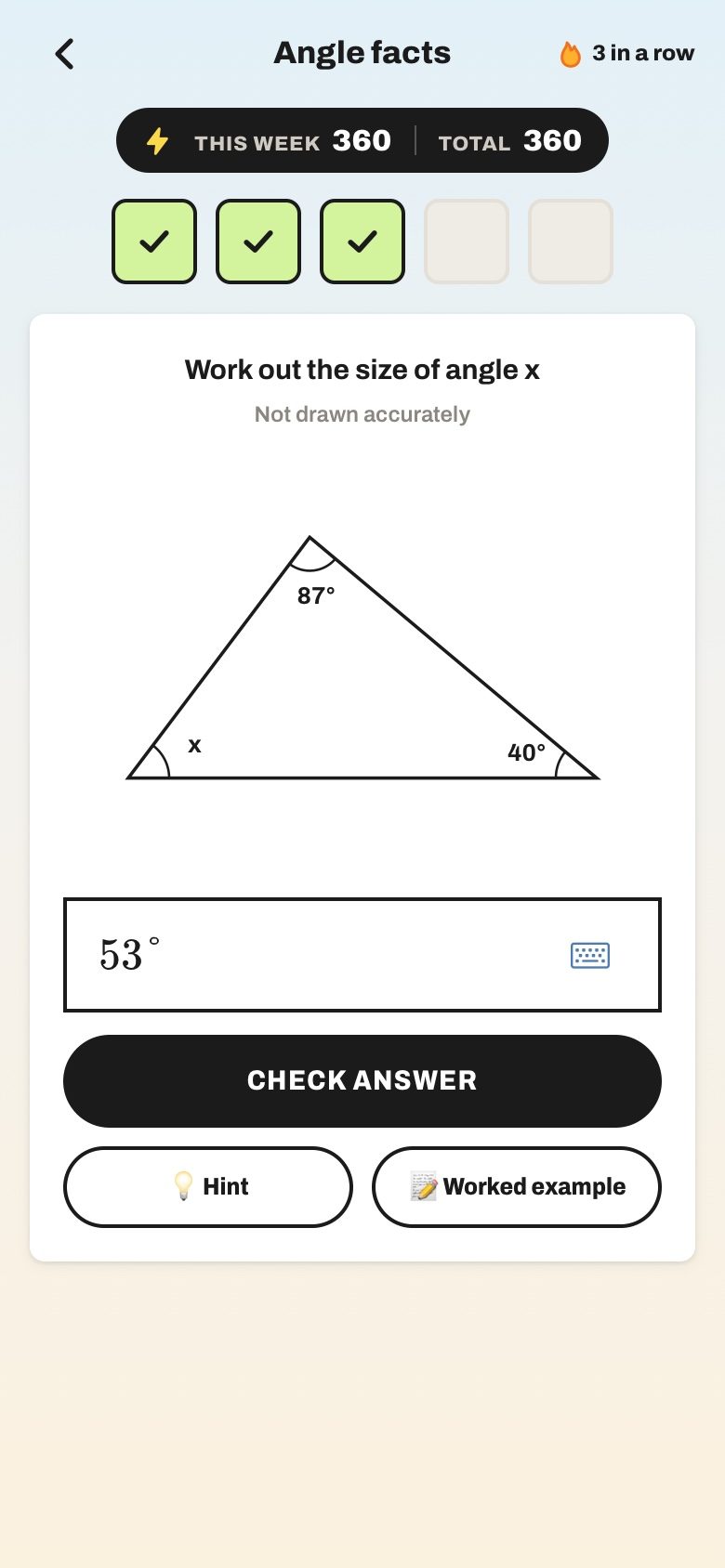
The hint says what to think about, never the answer. The worked example shows a similar question with different numbers, step by step. Then you try yours the same way.
- Help is never a penalty: right answers still earn points.
- Teachers can see which answers came with help.
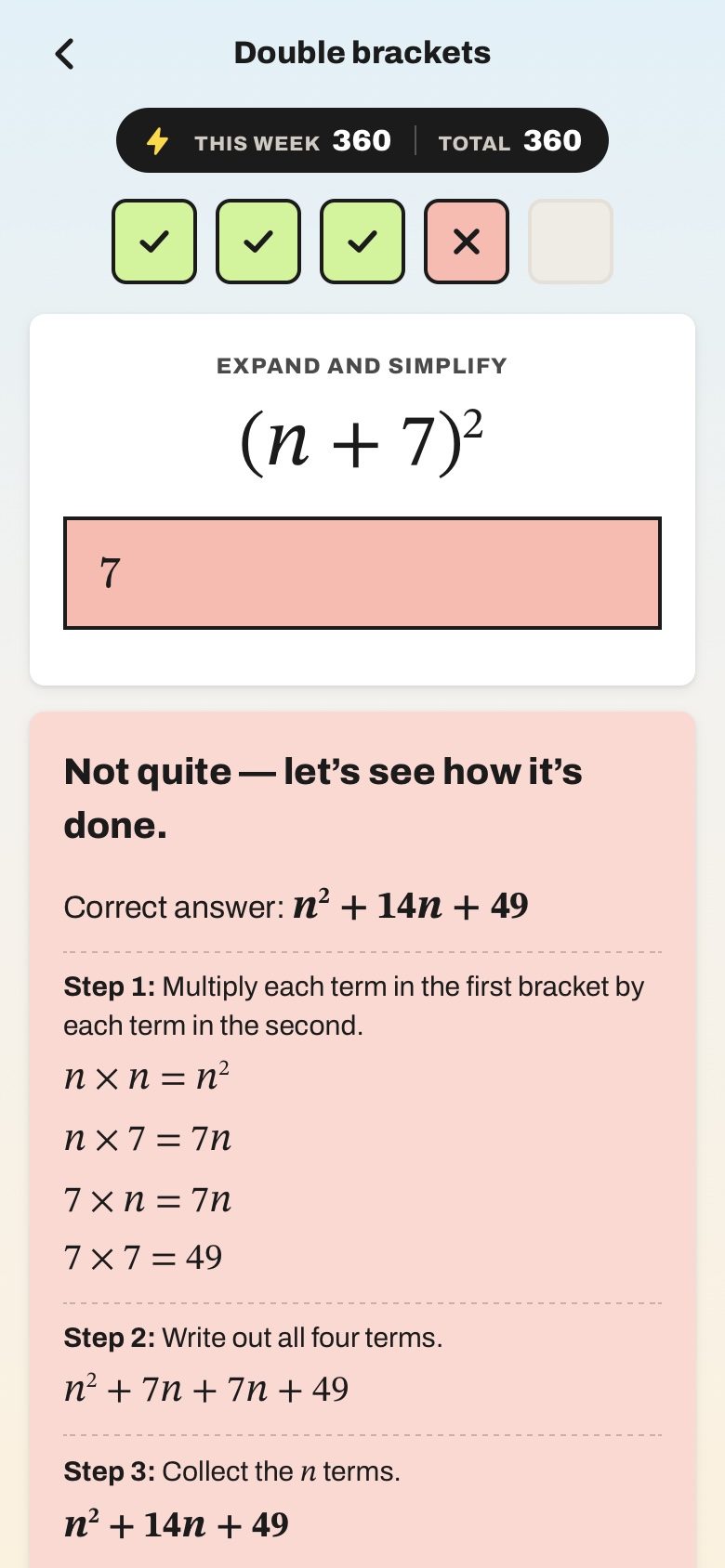
Wrong? See how it's done.
A wrong answer shows the correct one with the full working, so the mistake makes sense before the next question.
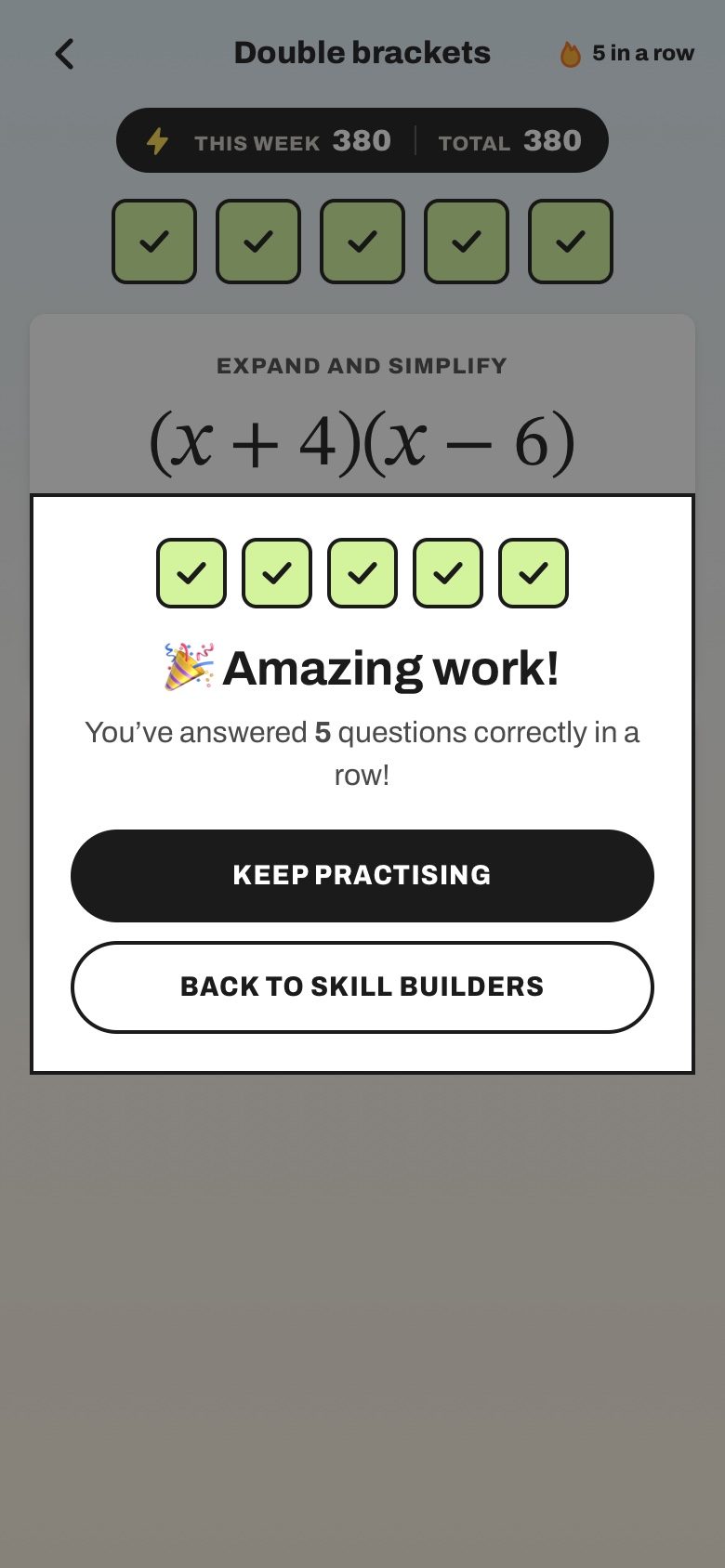
Five in a row makes a skill secure.
Five boxes show your last five answers. Get all five right and the skill turns green, with a celebration at 5, 10, 15 in a row and beyond.
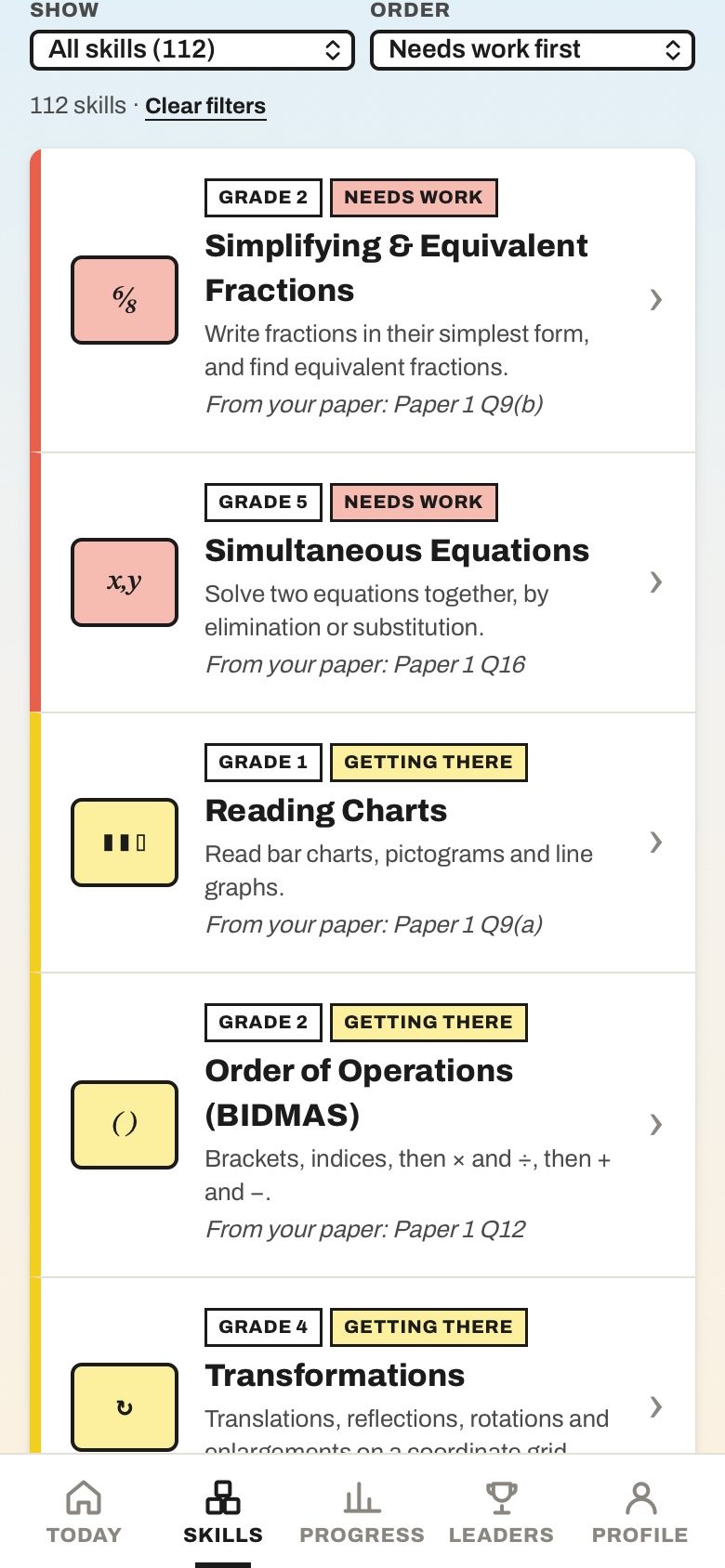
Your papers show what needs work.
Every question part on the daily papers is linked to a skill. Drop marks on one, and that skill turns red on the Skill Builders page, with the paper question that showed it.
- Needs work marks dropped on a paper.
- Getting there part marks, a hint, or practised since.
- Secure full marks, or five in a row.
- Recommended shows everything that needs work, plus skills your teacher recommends.
Recommend a skill to the class, or one student.
Pick any of the 127 skills and add a note. It appears on their Today and Skills screens straight away, and you can see who has practised it.
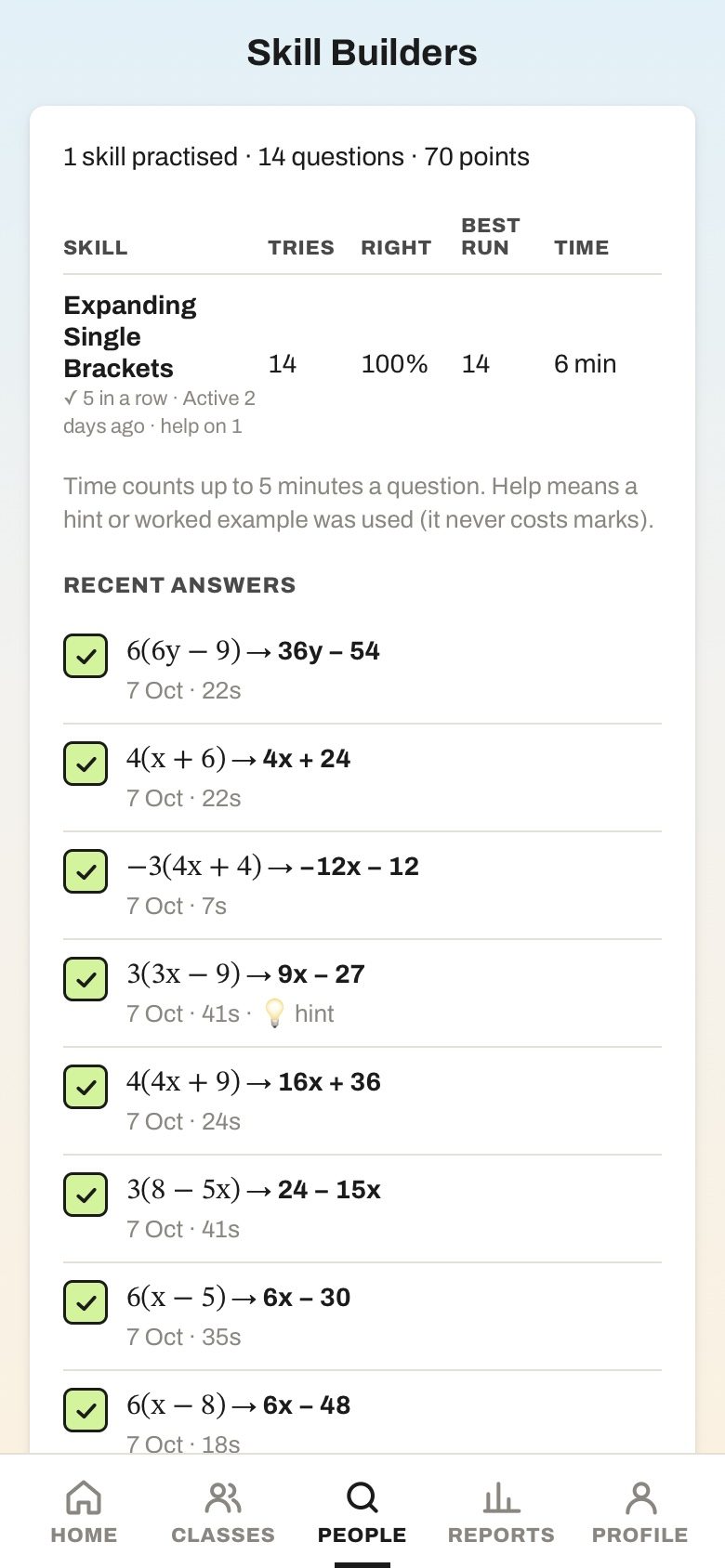
- Every student's practice: tries, accuracy, best run and time on each skill.
- Recent answers, with any hints or worked examples they used.
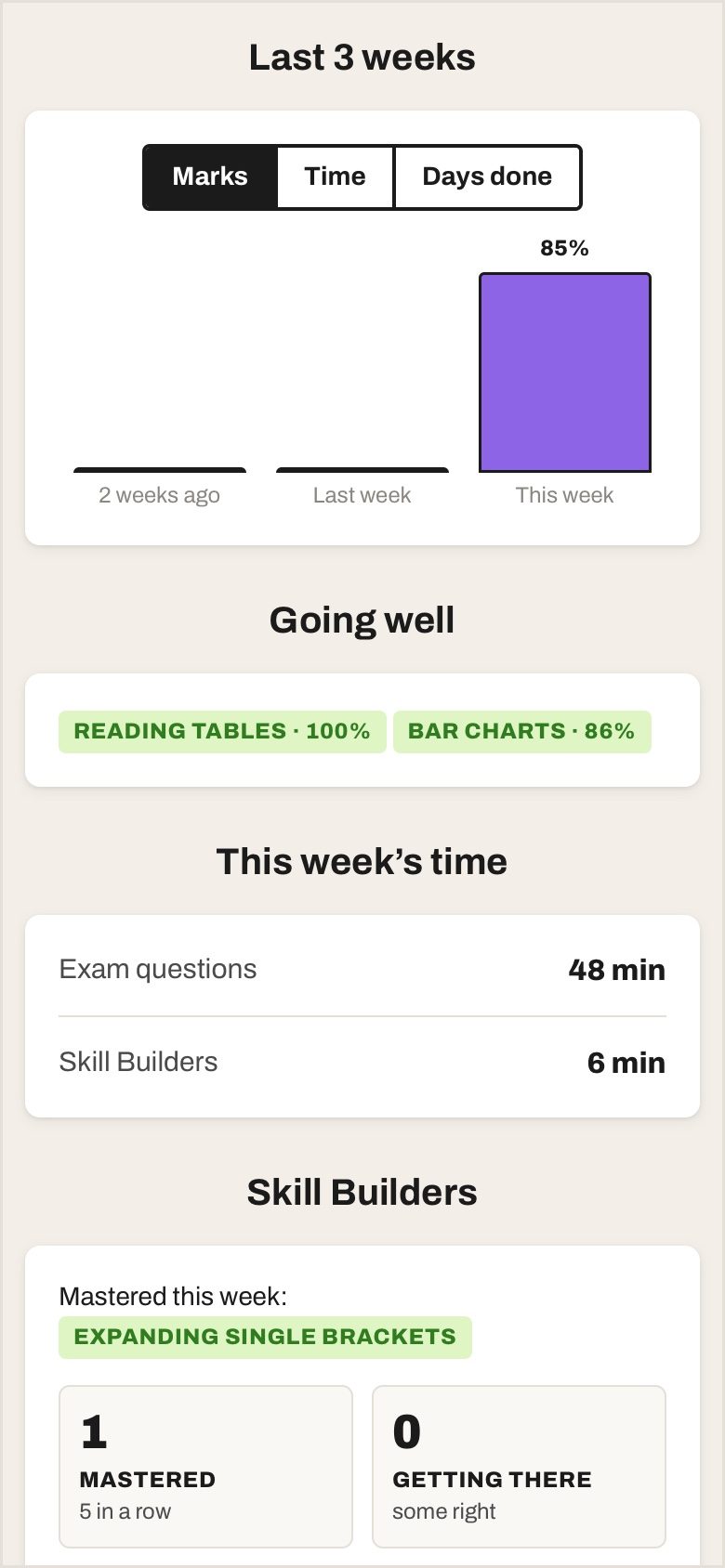
- Reports show skills mastered, getting there and needing work. More for teachers
Skills mastered, every week.
The weekly parent email lists the skills mastered that week. The full report starts with the areas to revise, each with the Skill Builder that helps.
- Time on Skill Builders each week, next to time on exam questions.
- Parent emails for school accounts. How they work
Practice counts on the leaderboard.
| Each right answer | 5 points |
| Every 5 in a row | +10 points |
| Most Skill Builder points in a day | 100 |
Hints and worked examples don't cost points. After 100 points in a day, practice still counts towards your skills, and points start again tomorrow.
All 127 Skill Builders
Every skill, with the typical GCSE grade. Higher marks a Higher-tier skill; Calculator means some or all of its questions allow one.
127 skills
Number 31
Number
- Place Value & Number WordsThe value of a digit, numbers in words and figures, × and ÷ by 10, 100 and 1000, and digit-card puzzles.
- Ordering NumbersPut decimals and negative numbers in order.
- Adding & Subtracting NegativesAdd and subtract with negative numbers.
- Multiplying & Dividing NegativesMultiply and divide with negative numbers, including powers.
- Order of Operations (BIDMAS)Brackets, indices, then × and ÷, then + and −.
- Written Multiplication & DivisionMultiply and divide without a calculator, including decimals.
- Squares, Cubes & RootsSquare and cube numbers, square roots and cube roots.
- Factors, Multiples & PrimesList factors and multiples, and find prime, square and cube numbers.
- RoundingRound to the nearest 10, 100…, to decimal places and to significant figures.
- Prime Factor DecompositionWrite a number as a product of its prime factors, in index form.
- HCF & LCMHighest common factors and lowest common multiples, including from prime factors.
- Estimating CalculationsRound every number to 1 significant figure to estimate an answer.
- Calculator SkillsReciprocals, powers and roots, and longer calculations, rounded correctly.
- Error Intervals & BoundsWrite error intervals for rounded and truncated numbers, and use bounds in calculations.
- Standard FormWrite numbers in standard form, and change them back to ordinary numbers.
- Calculating with Standard FormMultiply, divide, add and subtract numbers in standard form, without a calculator.
- Product Rule for CountingCount the ways to choose: menus, codes, arrangements and numbers with rules.
- Negative & Fractional IndicesWork out powers like 5⁻², 64^⅓ and (8/27)^−⅔ exactly.
- SurdsSimplify surds, multiply and expand them, and rationalise denominators.
Fractions, decimals & percentages
- Simplifying & Equivalent FractionsWrite fractions in their simplest form, and find equivalent fractions.
- Fractions of AmountsFind a fraction of an amount, and work backwards to the whole.
- Mixed Numbers & Improper FractionsChange between mixed numbers and improper fractions.
- Fractions, Decimals & PercentagesConvert between fractions, decimals and percentages.
- Percentages of AmountsFind percentages of amounts, with and without a calculator.
- Adding & Subtracting FractionsAdd and subtract fractions and mixed numbers, using a common denominator.
- Multiplying & Dividing FractionsMultiply and divide fractions and mixed numbers.
- Percentage Increase & DecreaseIncrease or decrease by a percentage, including sales, VAT and reverse percentages.
- Percentage ChangeWrite one number as a percentage of another, and find percentage change, profit and loss.
- Reverse PercentagesFind the original amount before a percentage increase or decrease.
- Compound Interest & DepreciationCompound interest, simple interest and depreciation, year by year or with a multiplier.
- Recurring Decimals to FractionsConvert recurring decimals into fractions using algebra.
Algebra 41
Expressions
- Collecting Like TermsSimplify expressions like 5x + 3y − 2x + y.
- Writing Expressions from WordsTurn words into algebra: 5 more than n, twice x minus 3…
- Substituting into ExpressionsWork out 3a − 2b when a = 5 and b = −2.
- Using Index LawsSimplify x⁴ × x⁵, y⁹ ÷ y³ and (a²)³.
- Rearranging FormulaeMake t the subject of v = u + at.
- Algebraic ProofWrite consecutive, even and odd numbers with n, simplify, and show a result is always a multiple of a number.
- Algebraic FractionsSimplify, add and multiply fractions with letters.
- Function Notation, Composite & Inverse Functionsf(3), fg(x), f⁻¹(x) and solving f(x) = 11.
Equations & inequalities
- Solving One-Step EquationsSolve equations like x + 7 = 12 and 4x = 20.
- Solving Two-Step EquationsSolve equations like 3x + 5 = 20.
- Equations with BracketsSolve equations like 5(x + 3) = 40.
- Solving Equations with Unknowns on Both SidesSolve equations like 5x + 3 = 2x + 18.
- Integer Solutions & Inequalities on a Number LineList the integers that fit, and read inequalities from number lines.
- Solving Linear InequalitiesSolve 5x − 3 > 17 and −5 < 2n + 1 ≤ 7.
- Simultaneous EquationsSolve two equations together, by elimination or substitution.
- Equations with FractionsSolve (x + 4)/3 = 5 and x/2 + x/3 = 10.
Quadratics
- Solving Quadratics by FactorisingSolve x² + 5x + 6 = 0 by factorising.
- Quadratic FormulaSolve ax² + bx + c = 0, giving answers to 2 decimal places.
- Completing the SquareWrite x² + 6x + 2 as (x + a)² + b, and find turning points.
- Quadratic Inequalities & RegionsSolve quadratic inequalities from their critical values, and work with regions bounded by straight lines.
Brackets & factorising
- Expanding Single BracketsMultiply out a bracket, like 3(2x + 4).
- Factorising into Single BracketsFactorise fully, like 6x + 9 = 3(2x + 3).
- Expanding Double BracketsExpand and simplify (x + 3)(x + 5).
- Factorising into Double BracketsFactorise x² + 7x + 12 into two brackets.
- Difference of Two SquaresFactorise x² − 49 and 4x² − 25.
- Expanding Triple BracketsExpand and simplify (x + 1)(x + 2)(x − 3).
- Factorising ax² + bx + cFactorise 2x² + 5x − 3 into two brackets.
Sequences
- Continuing SequencesFind the next two terms of a sequence.
- Finding the nth Term of Linear SequencesFind the nth term of 5, 8, 11, 14, …
- Geometric SequencesFind the common ratio, the next terms, or a later term.
- Quadratic Sequences (nth Term)Find the nth term of 5, 12, 23, 38, …
- IterationUse an iterative formula, step by step, to 4 decimal places.
Graphs & coordinates
- Coordinates & MidpointsFind the midpoint of a line, or a missing end point.
- Gradient & y-Intercept from y = mx + cRead the gradient and y-intercept, and write the equation of a line.
- Real-Life & Rate GraphsRead distance–time, speed–time and conversion graphs, and use gradients and areas.
- Drawing & Using Quadratic GraphsTables of values, turning points, lines of symmetry and solving equations from the graph of a quadratic.
- Recognising Graph ShapesRecognise straight-line, quadratic, cubic, reciprocal and exponential graphs from their equations and sketches.
- Equation of a Line Through Two PointsFind y = mx + c for the line through (1, 5) and (3, 11).
- Parallel & Perpendicular LinesPerpendicular gradients, and lines parallel or perpendicular through a point.
- Graph TransformationsTranslate, reflect and stretch graphs: y = f(x) + a, f(x + a), −f(x), f(−x), af(x) and f(ax).
- Equation of a Circle & TangentsUse x² + y² = r²: radius, points on the circle, chords, and the tangent at a point.
Ratio & proportion 16
- Simplifying RatiosWrite ratios in their simplest form, including with units and decimals.
- Unit ConversionsConvert lengths, masses, capacities and times.
- Time & TimetablesThe 12- and 24-hour clock, time differences, hours and minutes, and reading timetables.
- Sharing in a RatioShare an amount between people in a given ratio.
- Direct ProportionScale recipes and prices up and down using the unitary method.
- Best BuysCompare prices to find which pack is better value for money.
- Exchange RatesChange pounds into other currencies and back again.
- Scale Drawings & MapsUse scales like 1 cm to 5 m and 1 : 50 000 to find real and map distances.
- Ratio ProblemsWork out amounts when you know one part, or the difference between two parts.
- Ratios & FractionsTurn a ratio into a fraction of the whole, and a fraction back into a ratio.
- Speed, Distance & TimeUse speed = distance ÷ time, including times in minutes.
- Inverse ProportionMore workers, less time: problems where one amount goes up as the other goes down.
- Area & Volume Unit ConversionsConvert between units of area (cm², m²) and volume (cm³, m³, litres).
- Density & PressureUse density = mass ÷ volume and pressure = force ÷ area.
- Growth & Decay (Multipliers)Percentage multipliers, compound interest and depreciation.
- Proportion FormulaeDirect and inverse proportion with formulae like y = kx² and y = k/x.
Geometry 25
- Properties of 2D ShapesName triangles, quadrilaterals and polygons from their properties, and find their symmetry.
- Angle FactsAngles on a line, around a point, vertically opposite, and in triangles.
- Perimeter & Compound ShapesPerimeters, missing sides, and the area of L-shapes.
- 3D Solids, Plans & ElevationsFaces, edges and vertices of solids, naming solids, and drawing plans and elevations.
- Angles in Parallel LinesCorresponding, alternate and co-interior angles.
- Area of 2D ShapesArea of rectangles, triangles, parallelograms and trapeziums.
- Angles in PolygonsInterior angle sums, and the angles of regular polygons.
- Circles: Area & CircumferenceCircumference and area of circles, to 1 decimal place or in terms of π.
- Volume & Surface Area of PrismsVolume and surface area of cuboids and other prisms.
- Pythagoras’ TheoremFind a missing side of a right-angled triangle, and use Pythagoras in context.
- BearingsRead and work out three-figure bearings, including back bearings.
- Constructions & LociName loci and constructions, use scales for circles, and find the region that fits two rules.
- TransformationsTranslations, reflections, rotations and enlargements on a coordinate grid.
- Column VectorsAdd, subtract and multiply column vectors.
- Interior & Exterior Angle ProblemsWork backwards: how many sides does the polygon have?
- Arcs & SectorsArc length, sector area and sector perimeter.
- Trigonometry (SOH CAH TOA)Find missing sides and angles in right-angled triangles.
- Similar Shapes & Scale FactorsUse scale factors for lengths, and (Higher) areas and volumes of similar shapes.
- Exact Trig Valuessin, cos and tan of 0°, 30°, 45°, 60° and 90°, without a calculator.
- Congruence & Geometric ProofUse SSS, SAS, ASA and RHS to show triangles are congruent, find matching sides and angles, and set up a proof.
- Cylinders, Cones, Spheres & PyramidsVolumes and surface areas of cylinders, cones, spheres and pyramids.
- Trig GraphsThe graphs of sin, cos and tan: key values, turning points, symmetry and solving equations from 0° to 360°.
- Sine Rule, Cosine Rule & AreaUse the sine rule, the cosine rule and ½ab sin C in any triangle.
- Circle TheoremsUse the circle theorems to find missing angles.
- Vector GeometryWrite vectors in terms of a and b using routes round a shape.
Statistics & probability 14
- Reading ChartsRead bar charts, pictograms and line graphs.
- Mean, Median, Mode & RangeFind the mean, median, mode and range of a list of numbers.
- Basic ProbabilityProbabilities from bags and spinners, P(not), and tables that add to 1.
- Pie Charts (Calculating Angles)Work out the angles for a pie chart, and read frequencies back from it.
- Scatter Graphs & CorrelationDescribe correlation, spot outliers and estimate with a line of best fit.
- Two-Way TablesComplete two-way tables and use them to find probabilities.
- Sample Spaces & Listing OutcomesList every outcome in a grid, then count to find probabilities.
- Comparing Data & SamplingCompare two sets of data with an average and the range, read stem-and-leaf diagrams, spot outliers, and use samples.
- Averages from Frequency TablesMean, median, mode and range when the data is in a frequency table.
- Relative Frequency & Expected OutcomesEstimate how many times something will happen, and work out relative frequency.
- Estimated Mean (Grouped Data)Use midpoints to estimate the mean of grouped data.
- Venn Diagrams & Set NotationRead Venn diagrams, use ∩, ∪ and ′, and find probabilities.
- Tree DiagramsUse tree diagrams for two events, with and without replacement.
- Cumulative Frequency, Box Plots & HistogramsRead cumulative frequency graphs and box plots, and use frequency density in histograms.
No skills match. Try another grade or search.
Skill Builder questions
Do Skill Builders change my paper grade?
No. Your grade comes from your daily papers. Skill Builders earn points, and change the colour of each skill as you get better at it.
Is there a limit?
No. Practise as much as you like: every right answer earns points, and every answer counts towards your skills.
I'm doing Foundation. Which skills should I use?
Anything without the Higher tag. The 29 Higher skills are there for students sitting the Higher paper.
Can my teacher see my practice?
Yes. Teachers see the skills you've practised, how many you got right, your best run and your recent answers.
Is it included on the Home plan?
Yes. All 127 Skill Builders are included for students at a school and on the Home plan.
Practice that closes the gaps.
Sign in to start a Skill Builder, or ask us about bringing Daily GCSE to your school.
Email us at hello@threetalents.co.uk